Struggling with complex qualitative analysis software? See how Dr. Garcia Ramos simplified her workflow and published NSF-funded research using Delve.
Dr. Jennifer Garcia Ramos, now an independent researcher/scholar, was teaching general chemistry as a graduate student when ChatGPT emerged. Curious about its impact on learning in STEM, she turned her thoughts into a formalized research study funded by the National Science Foundation. Uncovering a breadth of insights, she later created an AI disclosure form where students would report each time they used AI and describe why they used it.
She used Delve’s qualitative analysis tool to code her qualitative data, which included the forms, surveys, and student interviews. She published her insights in an open-access paper, which shares actionable insights for educators to use in their own teaching contexts.
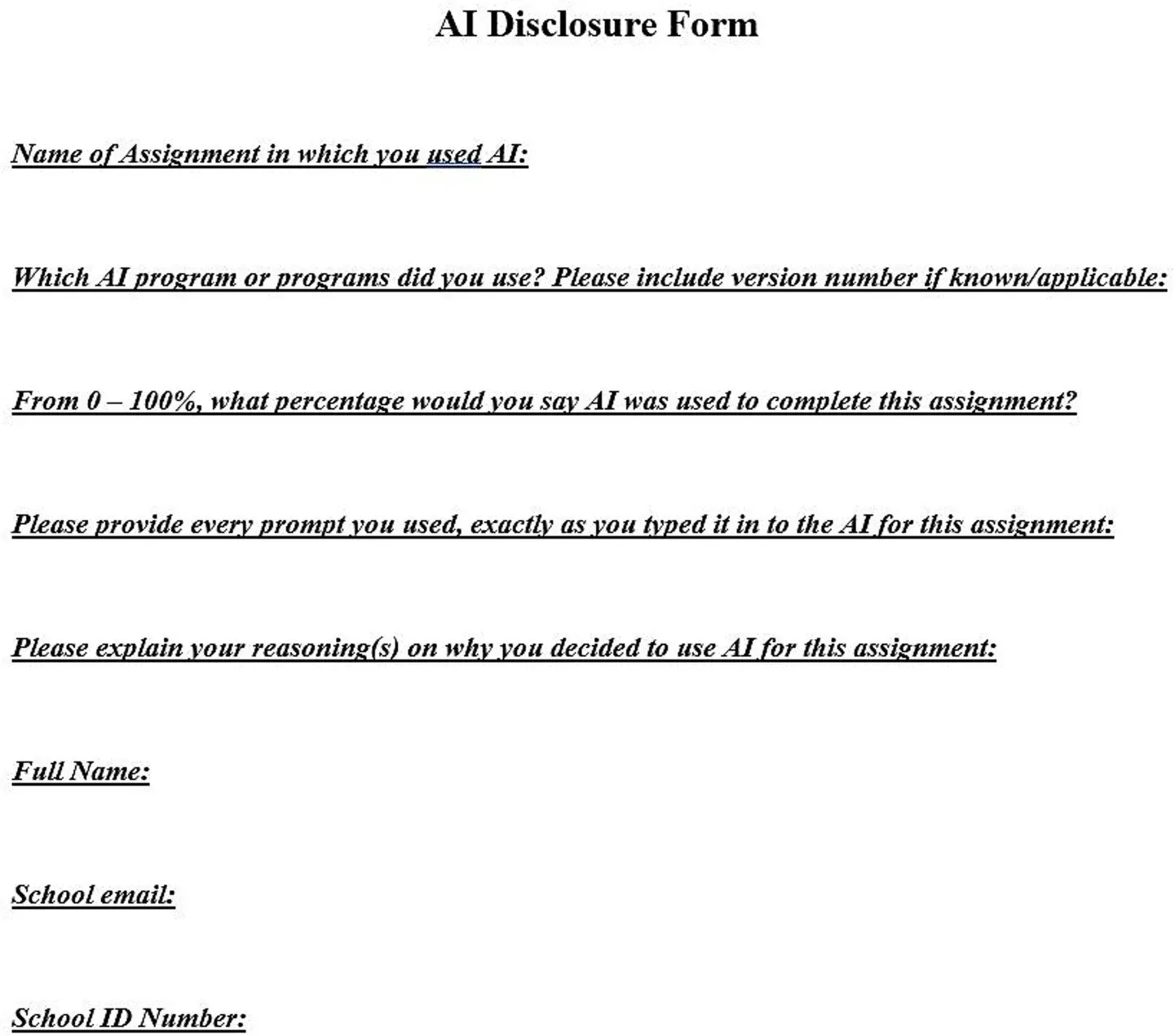
Source: AI Disclosure from Development and introduction of a document disclosing AI-use
Here’s a look at how she turned her real world classroom experience into a published paper, with the help of the Delve qualitative analysis tool.
Challenge: Traditional qualitative data analysis software was too complex and not collaborative
Dr. Jennifer collected substantial qualitative data across two related studies: 34 AI disclosure forms, 18 interview transcripts, and survey responses from 35 students. She needed a tool to help analyze this data.

In grad school, she was expected to use NVivo, but it was too complex to learn. She then tried MAXQDA, and even attended an exhausting all day training session, but its lack of collaboration capabilities meant it didn’t meet her needs.
After looking for something simpler, she found the Delve qualitative analysis tool, which had built-in collaboration capabilities and was very easy to learn.
Delve is easily accessible in its simplicity and intuitiveness. It saves a lot of time in comparison to other programs. You can see live on Delve how things are progressing. It takes a load of stress off because you can actually immerse yourself in the data rather than focusing on whether or not you are using the software correctly.
Solution: Using Delve to streamline analysis and enable seamless collaboration
Here’s how the Delve qualitative data analysis platform supported her research:
1. Getting started without downloads or delays
Delve is web-based, which means that Dr. Garcia Ramos didn’t need to download software. She and her collaborator could log in from anywhere and start working. The step-by-step video tutorials and learning center walked them through the basics.
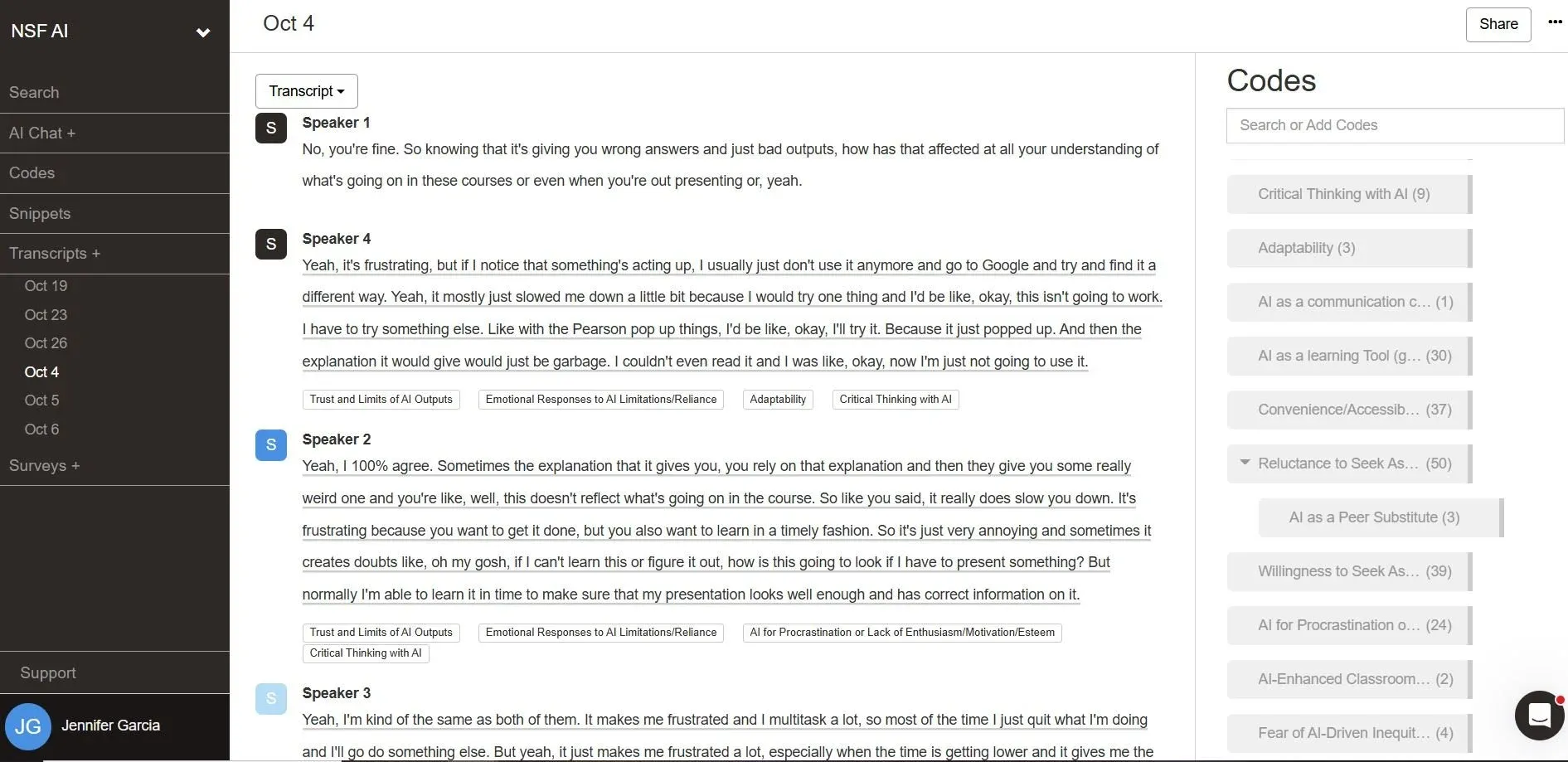
The way that Delve presents itself is inviting and simple. It’s full of information, but it’s delivered simply. I watched the tutorial videos and it was just super helpful.
2. Collaboration without complications
Delve’s collaboration features made it frictionless for Dr. Garcia Ramos to share projects and coordinate coding decisions with her collaborator. They were able to work separately, then compare results to build consensus.
We both used Delve. I added them to the account and that was it. It was their first time using Delve, and so they were able to easily navigate through the website.
3. Simple coding capabilities
Dr. Garcia Ramos used Delve to track patterns in how students talked about AI use. Delve enabled her to keep her transcripts organized in one central place. The coding system enabled her to easily edit and organize codes, empowering her to stay focused and immersed in data analysis.
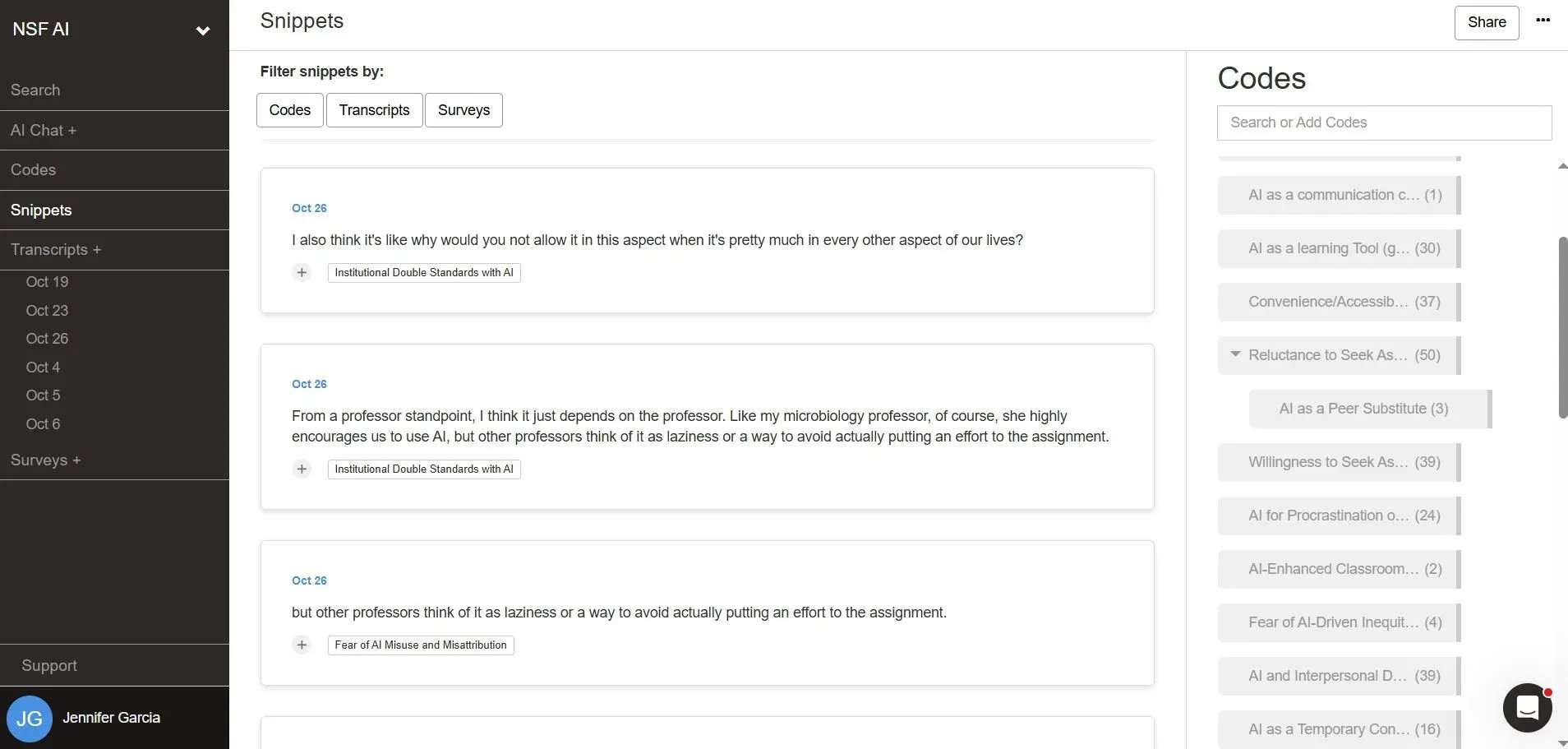
I love the drag and release feature. It’s easy to merge and unmerge and for you to create cascades for the coding.
Impact: Turning interviews to insights on AI’s role in STEM identity development
Delve’s qualitative analysis platform allowed Dr. Garcia Ramos to successfully complete her PhD studies and two studies on AI use in STEM communication courses. Both studies, linked in the next section, were published in the Journal of Chemical Education and Frontiers in Education.
Delve helped her identify critical findings about student AI use:
- AI enhances learning but requires critical evaluation: Students used AI for drafting work, but students also learned to fact-check the outputs and recognize when it provided incorrect information — developing critical thinking.
- AI supports time management but risks over-reliance: While AI helped students manage heavy workloads and overcome procrastination, it created concerns about dependence that made students question their own competencies.
- AI access and literacy affect equity and outcomes: Unequal access to premium AI tools and varying levels of digital literacy created disparate experiences, with some students gaining advantages while others felt left behind.
- Help-seeking behavior impacts AI dependency: Students who found professors intimidating or inaccessible turned to AI as a “safer” alternative, potentially missing opportunities for deeper mentorship and authentic skill development.
These insights resulted in published research articles in Frontiers in Education with actionable recommendations for equity-focused AI integration — all supported by Delve’s qualitative analysis capabilities.
Delve is awesome. Thank you for existing when I needed it the most for my graduate studies. I honestly don’t know what I would do without you guys. So thank you and keep it up!
See how Dr. Garcia Ramos’s papers referenced Delve
Dr. Garcia Ramos referenced Delve in the methodology sections of her published research, available here:
- The use of artificial intelligence in STEM communication-intensive courses and its impact on science identity
- Development and introduction of a document disclosing AI-use: exploring self-reported student rationales for artificial intelligence use in coursework: a brief research report
- Projecting Is Such Sweet Sorrow: Undergraduate Students’ Interpretation of Fischer and Haworth Carbohydrate Projections
- That with Glycosidic Visage: Undergraduate Students’ Interpretation of Glycosidic Bonds
Try a 14 Day Free Trial of Delve
You can find similar success stories of researchers using Delve to transform their data into meaningful insights in our UPenn case study. Dr. Katherine Miller explains how she used the QDA coding tool to organize 18 hours of workshop recordings for her dissertation on data literacy education.
If you’re looking for a straightforward way to analyze interview data, start with your 14-day free trial of Delve today.
Want to explore more qualitative analysis approaches?
Qualitative research methods:
- How to Do Thematic Analysis — Step-by-step guide for analyzing interview patterns
- Essential Guide to Coding Qualitative Data — Master the fundamentals of qualitative coding
- Complete Guide to Survey Analysis — Analyze open-ended survey responses effectively
- How to Use AI in Qualitative Research — Leverage AI tools to enhance your analysis
Comparing qualitative analysis software:
- Which QDA Software is Easiest to Learn? — Compare learning curves across platforms
- Which QDA Tool Makes Team Coding Easiest? — Find the best tools for research collaboration
- Which QDA Software Support Actually Helps? — Compare customer support across platforms
- AI Features in QDA Software Compared — How different platforms integrate AI capabilities